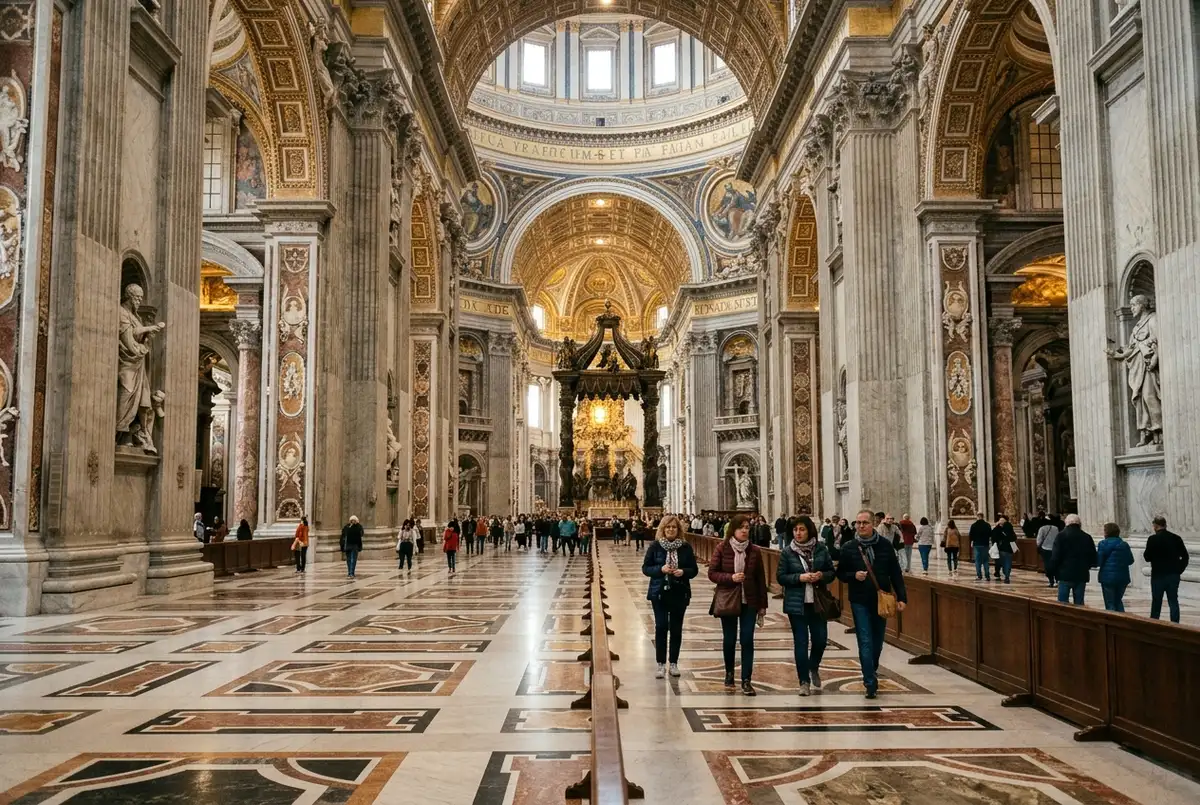
St. Peter’s Basilica and Michelangelo overlap in three places most first-time visitors don’t expect: the Pieta sculpture near the entrance, the dome overhead, and the underlying floor plan itself. He didn’t design the whole building from the ground up, and I think that detail actually makes the place more interesting, not less, since you’re looking at one genius picking up another architect’s unfinished plan and reshaping it decades later.
I’d start at the Pieta, since it’s the one piece in the entire Basilica that’s unambiguously, entirely his, carved while he was still in his early twenties.
Where is Michelangelo’s Pieta inside St. Peter’s Basilica?
Near the entrance, in the first chapel on the right as you walk in from St. Peter’s Square. The sculpture shows a serene, strikingly youthful Mary holding the body of Christ across her lap, carved from a single block of Carrara marble. It’s the only work Michelangelo ever signed, and I’d get close enough to read the inscription on the sash across Mary’s chest before the crowd behind you starts pushing forward.
It’s been sealed behind bulletproof glass since 1972, after a visitor attacked it with a hammer and damaged part of the figure. I’d mention that upfront, because older photos online show the statue fully exposed, which confuses people trying to match what they’ve seen on a screen to what they’ll actually see in person.
What is Bernini’s Baldachin, and why does it sit where it does?
A bronze canopy roughly 30 meters tall, built over the main altar directly above what tradition holds is St. Peter’s tomb. Four twisting bronze columns support it, and I’d argue it’s the single structure in the building that best captures the Baroque instinct for drama over restraint, a sharp visual contrast to the Renaissance calm of the Pieta nearby.
The Baldachin isn’t Michelangelo’s work. Gian Lorenzo Bernini designed it roughly a century after Michelangelo’s death, but I’d still put it on this list, because it stands directly beneath the dome Michelangelo did design, and the two pieces visually finish each other from almost any angle in the nave.
Is the Baldachin’s bronze really taken from the Pantheon?
Largely, yes, at least according to the pope who commissioned it. Pope Urban VIII had bronze stripped from the Pantheon’s ancient portico to help cast the Baldachin, a decision famous enough to spawn a contemporary Roman jab: “what the barbarians didn’t do, the Barberini did,” playing on the pope’s family name. I’d share that line with anyone who thinks ancient Rome and Baroque Rome never collided directly, because here they genuinely did, in bronze.
Did Michelangelo design the dome of St. Peter’s Basilica?
Yes. He took over as chief architect late in life and produced the design for the dome, but he died in 1564 before construction reached the drum, let alone the cupola itself. Giacomo della Porta finished the dome from Michelangelo’s plans, adjusting the curve to be slightly steeper than the original model.
I’d call this the most under-appreciated fact about the whole building. Most visitors assume whoever designed something also watched it get built, and here the two things are decades apart, with another architect’s hand genuinely shaping the final result overhead.
How is St. Peter’s Basilica laid out?
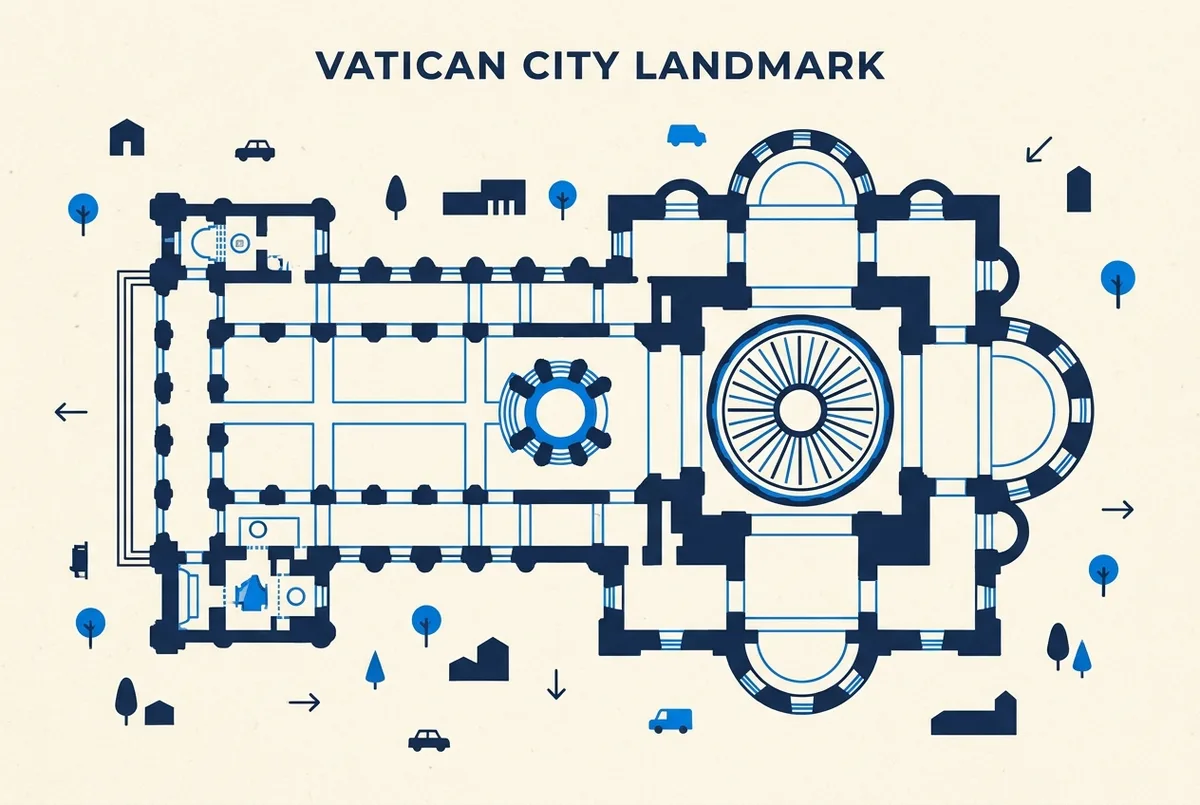
As a Latin cross, with a long nave leading to the altar beneath the dome and two transepts crossing it roughly two-thirds of the way down. The floor itself carries brass markers measuring the length of other major cathedrals, so you can stand near the entrance and see exactly how much longer St. Peter’s nave runs than, say, Notre-Dame’s or Milan’s Duomo.
I’d actually use those floor markers on your way in, before you’ve seen the scale up close elsewhere in the building. It’s a small detail, but it’s the fastest way to understand just how large the nave is before the art and the crowd start competing for your attention.
Who designed St. Peter’s Basilica before Michelangelo took over?
Donato Bramante drew the first plan in the early 1500s, favoring a Greek cross layout centered squarely under the dome. Several architects followed him, each adjusting the plan, before Michelangelo inherited the project decades later and pushed it back toward Bramante’s original centralized concept. Carlo Maderno extended the nave afterward into the Latin cross shape visitors walk through today.
I’d say this history explains why the building doesn’t feel like one architect’s singular vision, because it genuinely isn’t. It’s a relay of decisions across more than a century, and I think that’s part of what makes the floor plan worth reading about before you go rather than only admiring the finished result once you’re standing in it.
What other statues and art are worth slowing down for?
Beyond the Pieta, the Basilica holds dozens of papal tomb monuments along the side aisles, several by Bernini himself, including a bronze statue of St. Peter near the crossing whose foot has been worn smooth by centuries of pilgrims touching it on their way past. I’d budget a few extra minutes for the side chapels even if the Pieta and the dome are your main goal, since several hold genuinely significant tomb sculpture that gets skipped entirely on a rushed visit.
The confessio, a sunken area directly in front of the altar, offers a close look toward the traditional site of St. Peter’s burial without needing the separate Scavi excavation tour below. I’d treat it as the easiest way to connect with that history if you haven’t booked the Scavi tour months in advance through the Vatican’s own office, since that one needs its own standalone reservation.
Is it worth seeing St. Peter’s Basilica with a guide rather than on my own?
I think so, especially on a first visit. A guide points out exactly which chapel holds the Pieta, explains why the Baldachin sits precisely over the altar, and can walk you through the handoff between Bramante’s, Michelangelo’s, and Maderno’s competing plans in a few sentences, rather than you trying to piece it together from a guidebook mid-visit.
Our St. Peter’s Basilica guided tour guide breaks down what a licensed guide actually adds and how long to budget for the Basilica portion specifically.
Ready to see it in person? The Vatican Museums, Sistine Chapel and Basilica tour starts from $77.12 and bundles a guide through the Sistine Chapel straight into the Basilica, timed so you’re not standing at the entrance trying to find the Pieta on your own.
What should I know before I go, beyond the art itself?
The same security checkpoint and dress code apply here as everywhere else in Vatican City, and I’d sort both out before you’re standing in line with a bag you didn’t check. Our St. Peter’s Basilica security guide covers exactly what gets screened and what you can’t bring in.
If you’re weighing the Dome climb on top of everything described here, our St. Peter’s Dome climb guide lays out the honest stair count and who should think twice before booking it.
For the full picture of what’s free and what’s genuinely worth paying for at the Basilica, see our St. Peter’s Basilica tickets guide, which covers the guided tour, the Dome climb, and skip-the-line access side by side.
And if you’re still sorting out how the Sistine Chapel, the Museums, and the Basilica relate to each other geographically before planning your visit, I’d start with our visiting the Sistine Chapel guide, which lays out the basic geography first.
For more on the building’s seven-architect history, see St. Peter’s Basilica on Wikipedia.
Frequently asked questions
Did Michelangelo build all of St. Peter’s Basilica?
No. He designed the dome and reworked the floor plan late in his life, but architects before and after him, including Bramante and Maderno, shaped the rest of the building across more than a century.
Why is the Pieta behind glass?
It’s been protected behind bulletproof glass since a 1972 hammer attack damaged the statue. Before then, visitors could stand much closer to it unobstructed.
Is the dome Michelangelo designed the same one standing today?
Essentially yes, though Giacomo della Porta finished it after Michelangelo’s death and steepened the curve slightly from the original model.
Do I need a guide to understand the art and architecture?
Not strictly, but I’d book one on a first visit. The highlights are easy to walk past without someone pointing out which chapel holds the Pieta or why the Baldachin sits exactly where it does.
How long should I spend looking at the art inside?
Plan on 30 to 45 minutes if you want to see the Pieta, the Baldachin, and a few side chapels without rushing. Add more time if you’re also doing the Dome climb or the confessio.
My bottom line: Michelangelo’s role here is bigger than most people assume, and smaller than a few myths suggest. He’s responsible for the dome and the underlying plan, not the entire building, and I think that’s a more interesting story than the oversimplified version most guidebooks tell. If you only have time for two things inside, I’d make them the Pieta and a long look straight up at the dome.
compare every Sistine Chapel ticket and tour →